FIN 711:
The Lifecycle of a Firm
Learning Experience Design Case
With the rise of artificial intelligence and online degrees as standard forms of higher education, how can we create an online MBA experience that fosters genuine peer-to-peer and student-to-instructor engagement, rigorous application of real-world scenarios, and authentic assessments?
To answer this question, the Ross Office of Digital Education collaborated with finance professor Dr. Gautam Kaul and Instructional Support Specialist Joshua Phan-Gruber to develop an innovative online MBA course titled “FIN 711: The Lifecycle of a Firm.”
This course provides insight into the strategic and financial decisions a company faces throughout its lifecycle, from the early stage to maturity.
Multidisciplinary, Case-Based Learning
This course fills a crucial gap in the typical graduate business school curricula by focusing on early-stage companies rather than mature firms. It tracks an early-stage company’s lifecycle from a venture capital perspective: startup, growth, and maturity. To closely simulate the investment due diligence process, three real early-stage companies’ data were anonymized and uploaded to their “Data Room.” The Data Room is a dedicated Canvas page that includes the anonymized startup’s pitch deck, founder interviews, feedback from operating partners, a financial overview, and a market size report. Deal Teams (student groups) access the Data Rooms for the necessary information regarding the startups.
Course assessments mirror common deliverables in the venture capitalist business world: strategy and business model analysis, market size evaluation, climate impact assessment, and financial model. The early stage of the course culminates with each deal team writing an investment memo and justifying their investment decision.
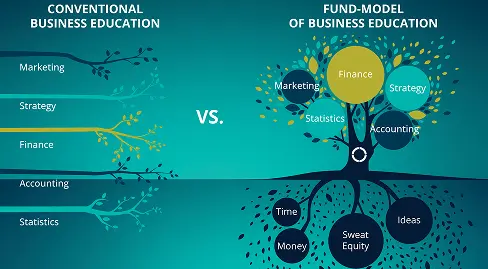
To successfully complete each deliverable, students must utilize foundational knowledge from multiple academic areas, such as accounting, finance, strategy, and statistics. The Deal Teams wrestle with the inherent ambiguity in complex investment decisions and apply their multidisciplinary knowledge to assert and defend informed investment decisions.
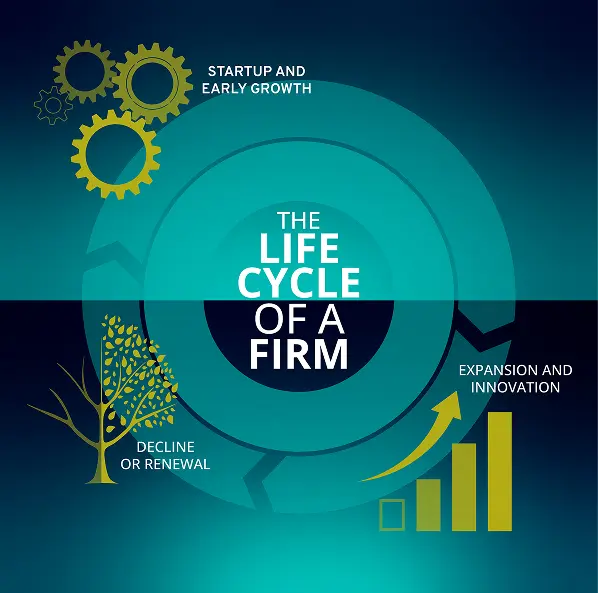
The Office of Digital Education Art Department developed a custom color scheme and animated course banner. The use of muted colors and nature-themed images was intended to parallel the business lifecycle with similar cycles in animals and plants, such as the butterfly lifecycle. This deviates from the typical online Ross MBA course, largely University of Michigan colors: maize and blue.
As the course progresses, the companies continue to evolve; rather than wait years for a company to mature, the startups progress to growing and then mature firms. In Week 5, students receive a strategic report detailing potential decisions and their financial implications. Deal teams are tasked with selecting and defending their company’s strategic next move.
Finally, as the companies enter the maturity phase, deal teams assess the impact of their strategic choices. The Data Room provides additional information about growth, valuation, and leverage, enabling the Deal Teams to report on their company’s final financial model.
The Office of Digital Education Art Department developed a custom color scheme and animated course banner. The use of muted colors and nature-themed images was intended to parallel the business lifecycle with similar cycles in animals and plants, such as the butterfly lifecycle. This deviates from the typical online Ross MBA course, largely University of Michigan colors: maize and blue.
Collaborative Action-Based Learning
To mirror the authentic demands of the workplace, the course’s learning design intentionally includes ambiguity, requiring critical thinking and decision-making without clear answers. Students consider complex and ambiguous investment decisions, but not without support. Foundational to Professor Kaul’s pedagogy is the formation of the Deal Team (student groups). Chosen at the start of the term, students engage in designated team meetings to discuss the week’s content focus, review low-stakes practice opportunities, and collaborate on a weekly deliverable and team presentation. Group work and live sessions foster teamwork and presentation skills. Therefore, the course carefully balanced students’ struggles while providing guidance and support.
Typically, a 2.25-credit online MBA course includes fourteen asynchronous modules and four synchronous live sessions spaced across a seven-week term. Instead of using this segmented approach, the content is divided into weekly sections organized within stages of the firm’s lifecycle. The stages intuitively flow to the next as students explore themes associated with the lifecycle timeline. An optional live session solicits student input on the course’s content and design. By proactively increasing instructor-to-student and peer-to-peer interactions, students build a thriving community of inquiry.



"The teaching faculty was incredibly effective in my opinion… They put care and attention into developing the narratives and the assignments, providing meaningful feedback, and allowing for engaging discourse in the live sessions. Easily a Top 3 course I've taken in this program."
"The Lifecycle of a Firm" was offered to students for the first time in Winter 2025 and received overwhelmingly positive feedback. Professor Kaul and Josh were commended for their expertise and passion in creating an engaging learning environment that connects course content with broader program topics. Students praised the course for successfully integrating strategy, finance, and marketing through a hands-on approach, allowing them to learn something new and practical each week. The course effectively challenged them to navigate ambiguity and make decisions, simulating real-life company evaluations.
Students agreed that the weekly content focus deepened their understanding of venture capital investment and valuation. They valued the course's real-world applicability, systematic approach, and dynamic discussions. Indeed, many students found the course relevant to their careers and aspirations, even if they do not work in the startup venture capital space.
Students appreciated learning "hard skills," such as analytical methods, and "soft skills," including problem-solving, communication, and handling ambiguity. Students noted that navigating the course's intentional ambiguity improved their ability to synthesize data and evaluate early-stage companies effectively. Many also appreciated the course's design, which encouraged them to develop their own assumptions and craft solutions independently.
Moving Forward
As the first online MBA course created exclusively by the Ross Office of Digital Education and Ross faculty, “The Lifecycle of the Firm” offers a model for future course development. In retrospect, the following components are key to successful course delivery.
Collaborative Kindness
This team collaboration was guided by respect, open communication, and dedication to the project. All voices were heard, compromises were made, and hierarchy was diminished. This led to the development of a true kinship among team members, which was critical to the success of the course.
Passionate Commitment
Online courses always require more work and time than expected. All team members were passionate about the course's content and pedagogical style, which was reflected in their willingness to create content, collaborate in meetings, and respect internal timelines throughout the year-long process.
Humanized Process
This course succeeded largely because the faculty's unique style and vision could deviate from the standard online MBA course. The personalization of the course, from content delivery to visual theming, communicates to students the passion and personality of the faculty member. These humanized elements create an enhanced student learning experience and an authentic faculty teaching experience.test
Meet the Team
“The Lifecycle of the Firm” was developed through the hard work and dedication of the following collaborators:
Professor Gautam Kaul, Lead Faculty
Dr. Kaul is known for his distinguished career in finance, including innumerable contributions to research and teaching at Michigan Ross. Despite his decorated CV, he prefers students to call him “Gautam” or “G” and adopts a collaborative relationship with faculty, staff, and students alike. Gautam is the Managing Director for three programs at Ross (Michigan Climate Venture, Social Venture Fund, and International Investment Fund), which allows graduate students to conduct due diligence and make investment decisions. When not saving the world through finance, Gautam enjoys sharing his love for good music and revolutionizing higher education.
Joshua Phan-Gruber, Instructional Support Specialist
Josh graduated with a dual MBA/MA from the Ross School of Business and the Erb Institute's School for Environment and Sustainability. He worked closely with Professor Kaul as the Director of Fund Operations for the Michigan Climate Venture investment fund. In his spare time, he enjoys drinking kombucha, spending time in nature, and using his background in musical theater to entertain locals by singing karaoke.
Lori Woods, Senior Media Designer, Art Department
Lori Woods is an award-winning Senior Visual Designer and Art Director with over a decade of experience in motion graphics, branding, and immersive digital content. She's led creative campaigns for Fortune 500 brands and now drives innovation in online education at the University of Michigan's Ross School of Business. Lori is passionate about storytelling and design strategy, blending creativity with purpose to inspire connection and clarity. Outside of work, when she's not creating, Lori is learning the strategy of Pickleball, enjoying the joy-filled chaos of her 6-month-old Golden Retriever puppy, Honey Blue, and cherishing time with her grandson Charlie and family. She believes in laughter, lifelong learning, and doing work that feels like play.
Sarah DeWard, Senior Learning Experience Designer
Sarah DeWard is a former sociology and gender studies faculty member turned Ross Office of Digital Education learning experience designer. She enjoys applying her higher education experience to facilitate authentic faculty teaching and innovative student learning in online education. In her free time, Sarah enjoys fostering abused and neglected dogs, amateur gardening, and advocating for social justice.